
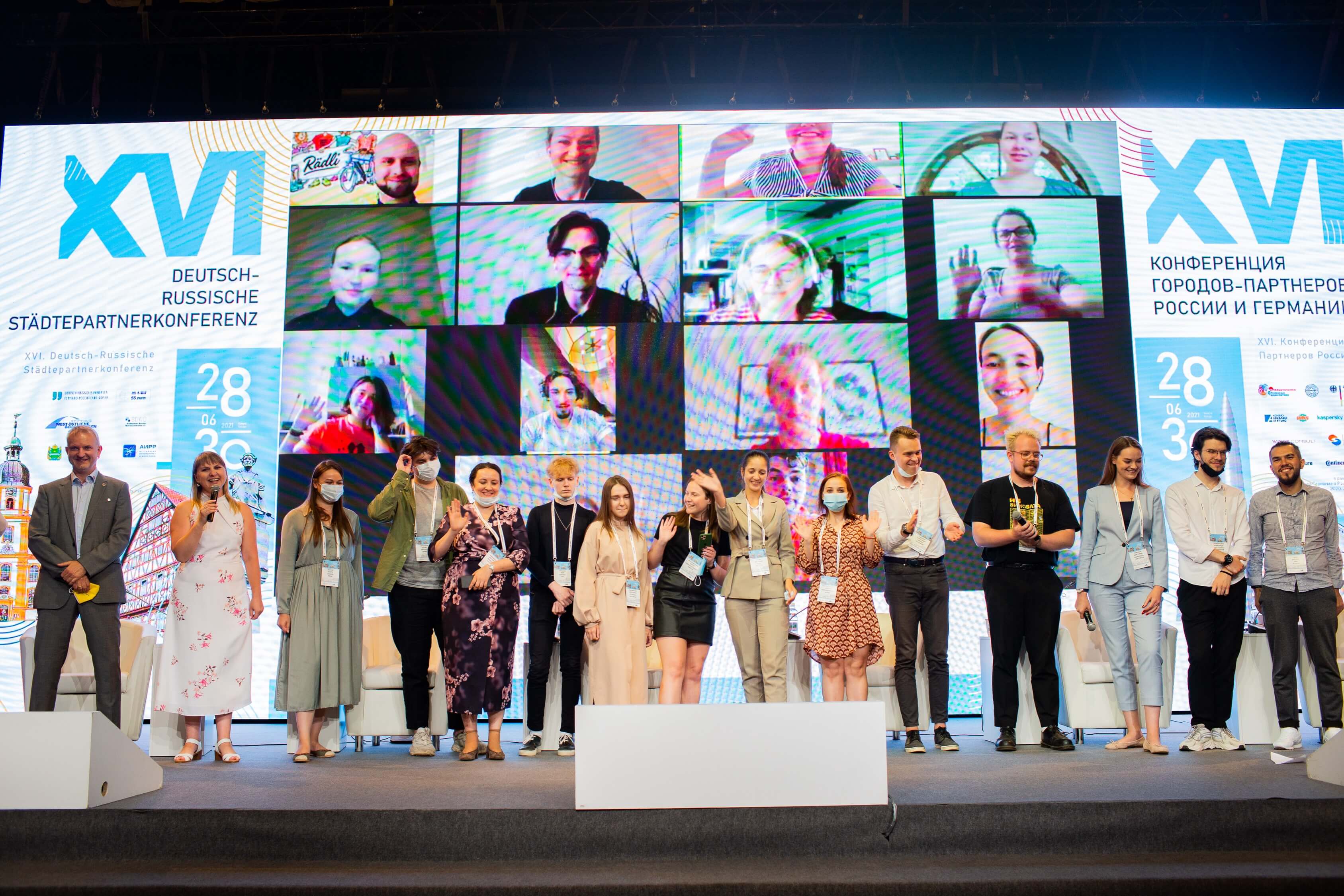
Such an initiative was made by the Russian Coordination Bureau for Youth Cooperation with Germany and the German-Russian Youth Exchange Foundation following the results of the IV Youth Forum of Partner Cities of Russia and Germany, the outcomes of which were presented on June 30 in Kaluga at the XVI Conference of Partner Cities of Russia and Germany.
The forum was held in a part-time format in Moscow and Kaluga from June 23 to July 1 and brought together 50 young people and 9 partner teams – Vladimir / Erlangen and Jena, Nizhny Novgorod / Essen, St. Petersburg / Hamburg, Perm / Duisburg, Tver / Osnabruck, Kaliningrad / Bonn, Gatchina / Ettlingen, Ufa/Halle, Krasnodar / Karlsruhe.
This is the first project since April 2020 within the framework of the bilateral Youth Exchange Program that took place in person. The topic of the forum is “Digitalization as a chance for cooperation”.
“Today is really a very important event. Despite all the difficulties with the pandemic situation, you have come together, and I think this is a good sign. There is a lot of good news in Russian-German relations, and your forum, the fourth Forum, is evidence of this.
Digitalization has become a part of urban life today, you will talk about it, and a very important part of the economy, in general, is a part of the global world, because today many processes take place online, but in fact nothing can replace live human communication. It is in the world of global digitalization that this communication becomes the luxury that people always need sometimes more than essential goods. Therefore, it seems to me during these three days and of course during your trip to Kaluga, and Kaluga is one of the most beautiful cities in central Russia and a very dynamically developing region, among other things, economically, you will be interested and you will be able to communicate with each other. I advise you all the same from time to time and as often as possible to be distracted from gadgets and look into each other’s eyes, it helps a lot. In order for both people and nations to understand each other better and realize they have common and important goals and tasks ahead,” the Special Representative of the President of Russia for International Cultural Cooperation Mikhail Shvydkoy said.
“Youth exchange and Partner Cities. These are two main directions of the Year of Germany in Russia. Today these spheres act in conjunction. This link is not accidental, because both directions are devoted to big questions of the future. We are talking about climate protection, digitalization and sustainable development. These are your desires, your dreams and, above all, your ideas on which our common future depends. Therefore, I would like to encourage you: take part! Get in touch with each other! Exchange ideas!
The Federal Foreign Office will assist you in this. That is why it was important for us that youth exchange be the focus of the Year of Germany in Russia. The goal of the Year of Germany is to build bridges for exchanges between German and Russian civil societies. This is more important than ever in difficult times, but despite difficult political conditions, we must and want to give our societies – and young people in particular – the space to listen to each other, to communicate, to engage in dialogue. The last year and a half of the coronavirus pandemic has been difficult for all of us. Especially it was a difficult time for the youth exchange. Therefore, I would like to express special thanks to the German-Russian Youth Exchange Foundation and the Russian Coordination Bureau for Youth Exchanges with Germany. Thanks to their great dedication, they managed to maintain a thread of contacts even during this difficult time. It took a lot of improvisation, but it was worth it. I am sure many of the digital solutions tested during this time will remain in the future,” Michel Müntefering, the Minister of State for Foreign Cultural Policy of the German Ministry of Foreign Affairs, said in a video message.
During the 9 days of the forum participants got acquainted with the priority areas of bilateral youth cooperation, were trained at seminars on the topics “Opportunities and methods of digital cooperation”, “Digitalization of the city”, “Digitalization of youth exchanges”, “Digitalization opportunities in public relations”, “Funding opportunities” and others, met with experts in the field of Russian-German regional-municipal partnership.
The forum resulted in ideas for joint projects:
- creation of a podcast about the development of partnership between the cities of Ufa/Halle,
- an Internet quest to get acquainted with the history and development of the Tver/Osnabruck partnership dedicated to the 30th anniversary of partnership between these cities,
- 3-part youth project of partner cities Krasnodar/Karlsruhe/Nancy,
- excursion route for young people (Vladimir / Erlangen and Jena),
- festival of street art, young artists and urbanists (Nizhny Novgorod / Essen),
- online discussion platform “New bridges connect old cities” (Kaliningrad / Bonn),
- bike ride Gatchina / Ettlingen,
- educational project to raise the level of environmental culture (St. Petersburg / Hamburg),
- online project to promote volunteering among youth (Perm / Duisburg).
The forum was organized by MIREA – Russian Technological University performing the functions of the Russian Coordination Bureau for Youth Cooperation with Germany, the German-Russian Forum and the German-Russian Youth Exchange Foundation with the support of the Ministry of Science and Higher Education of the Russian Federation, the Government of the Kaluga Region, the City Council of Kaluga, International Association “Twin Cities” and the Federal Foreign Office of the Federal Republic of Germany.
